PET Fibers and Filaments with Higher Recycled Content
When using rPET, internal scrap, or fiber-to-fiber recycled feedstock, intrinsic viscosity (IV) and performance typically drop, limiting recycled content in demanding fiber applications.
Reactive Recycling™ rebuilds polymer performance in the melt and enables higher recycled content using existing equipment and normal processing temperatures.
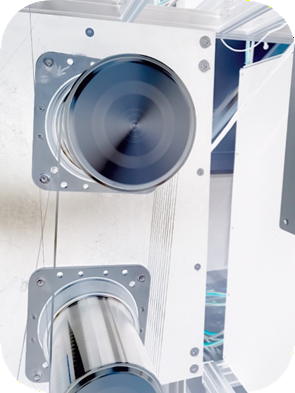
Why recycled PET becomes difficult in fiber production
Recycled PET streams often come with lower IV and higher variability, which can lead to:
- Reduced process stability and narrower spinning window
- Higher risk of interruptions and breaks at elevated recycled content
- Lower and less predictable mechanical performance in demanding fiber applications
This is especially critical in continuous filaments / textile yarn, where tenacity and stretching performance must remain high.
Reactive Recycling™ for PET fibers
Reactive Recycling™ is applied as a heat-activated masterbatch that can be pre-compounded or added directly in the spinning line.
It works with existing extrusion equipment at normal processing temperatures.
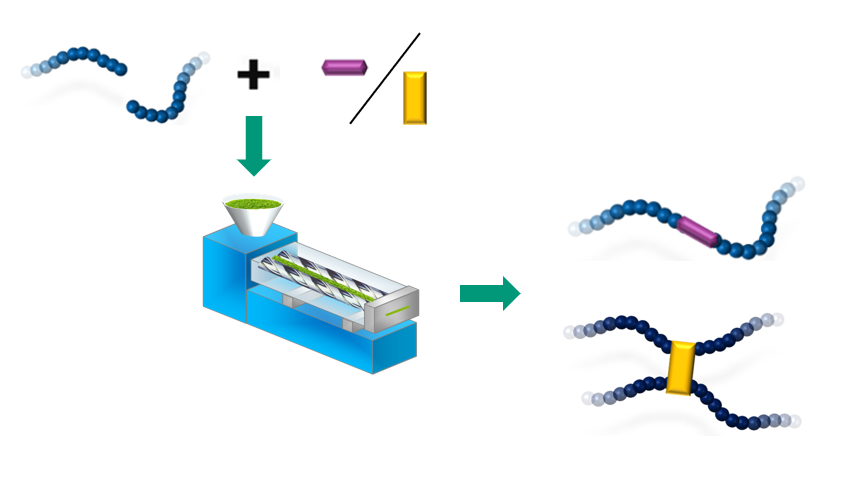
Melt modification with NEXAMITE® masterbatches in the extruder.
Two fiber categories – two IV enhancement routes
To achieve both process stability and mechanical performance, the IV enhancer must match the fiber type.
Continuous filaments / textile yarn (performance sensitive)
For continuous filaments, a linear chain extension approach using NEXAMITE® M992000 is the recommended solution to increase IV while maintaining or improving mechanical properties.
Staple fibers & carpet fibers (proven with standard solution)
For staple and carpet fibers, NEXAMITE® M021200 is the proven IV enhancement route that enables broader feedstock selection and stable production performance.
NEXAMITE® M992000 — linear IV enhancement for continuous filaments
NEXAMITE® M992000 is a reactive masterbatch for linear chain extension, particularly suited for continuous filaments / fibers, delivering higher IV and improved mechanical performance.
This includes improved tenacity and stretching performance.
Key benefits
- Enables broader feedstock, including fiber-to-fiber recycled materials, without compromising performance
- Improves throughput stability and reduces downtime from fiber breakage through improved spinnability and melt behavior
- Improves melt processability and control during spinning while increasing IV
- Boosts mechanical properties such as higher tenacity and improved elongation / stretching performance
- Compatible with existing PET fiber production lines and equipment
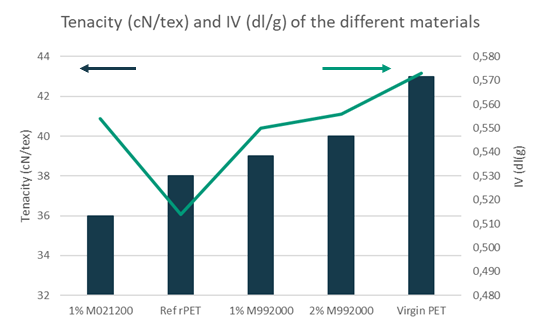
IV increase (green line, right axis) of rPET from fibers and effect on tenacity (blue bars, left axis).
NEXAMITE® M021200 – proven IV enhancement for staple and carpet fibers
For staple fiber production, NEXAMITE® M021200 provides a fast and cost-effective IV increase, enabling wider feedstock selection and more stable operation.
Key benefits
- Enables wider feedstock selection
- Allows use of lower-IV material to reduce cost
- Supports more consistent throughput and reduced downtime from fiber breakage
- Stabilizes pressure in the spin-block
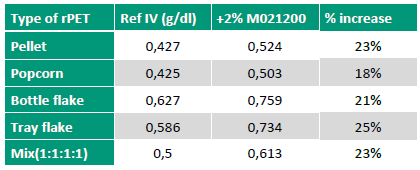
Effect of NEXAMITE® M021200 on rPET mix with starting IV of 0.5 dl/g.
Quick selection guide
Choose M992000 when you run
- Continuous filaments / textile yarn
- Fiber-to-fiber recycled feedstock
- High demands on tenacity and stretching performance
Choose M021200 when you run
- Staple fibers
- Carpet fibers
- Broad rPET feedstock mix where stable IV increase is needed
Product page: IV enhancers for rPET
Increase recycled content without compromising fiber performance
Share your feedstock type (bottle flake, tray flake, fiber-to-fiber, internal scrap) and your fiber process.
We help select the right IV enhancement approach and define trial settings.
Discuss your application
Share your material, process, or requirements — our team will help you find the right solution.