clean this code with the previous rules:
Control Processing and Melt Flow in Recycled Polypropylene
Adapt recycled polypropylene to your processing requirements by controlling melt flow (MFR), improving consistency, and enabling higher recycled content.
Nexam Chemical provides solutions to both increase and decrease MFR, allowing you to use lower-quality or out-of-spec feedstock while meeting application specifications.
Challenges with recycled polypropylene
Recycled polypropylene (rPP) often varies significantly in melt flow rate (MFR) and material quality, leading to:
- Inconsistent processing behavior
- Poor mould filling or excessive flow
- Variability between batches
- Difficulty meeting target MFR specifications
- Need for blending with virgin material
These challenges limit both productivity and recycled content.
Control MFR with Reactive Recycling™

Reactive Recycling™ enables controlled modification of polymer structure during processing.
This allows you to:
- Increase or decrease MFR depending on application
- Tailor material properties to processing requirements
- Use lower-quality or mixed recycled feedstock
- Achieve consistent production performance
Key benefits
- Tailor MFR to match application requirements
- Meet specific MFR targets consistently
- Enable use of lower-quality recycled feedstock
- Reduce reliance on virgin PP
- Improve process stability and repeatability
NexCircle® R403 — efficient MFR reduction
NexCircle® R403 is a next-generation reactive masterbatch designed to efficiently decrease MFR and increase melt strength in recycled polypropylene.
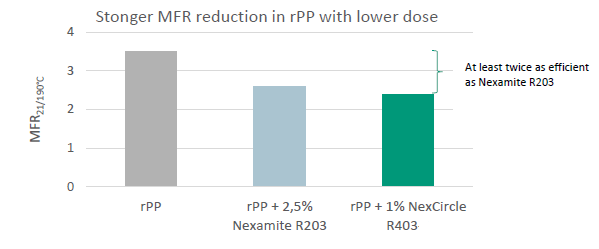
Comparison of MFR decrease in rPP with NEXAMITE® R203 and NexCircle® R403.
Key benefits
- Efficient reduction of MFR in recycled PP streams
- Improves melt strength and processability
- Enables use of lower-quality or mixed feedstock
- No negative impact on colour or additives
- Can compatibilize rPP contaminated with rPE
- Higher efficiency compared to previous generations
Application examples include injection moulding and extrusion processes requiring controlled flow.
NEXAMITE® R203 — established MFR reduction solution
NEXAMITE® R203 is a proven solution for decreasing MFR and improving consistency in recycled PP.
Key benefits
- Reduces MFR and stabilizes processing
- Improves consistency between batches
- Compatibilizes PP with PE contamination
- Reliable and widely used solution
NEXAMITE® R202 — increase MFR and improve flow
NEXAMITE® R202 is a reactive masterbatch used to increase melt flow in recycled polypropylene, enabling improved processability in flow-limited applications.
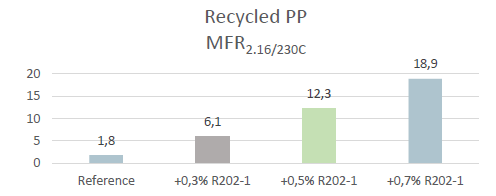
Effect on MFR with increasing amount of NEXAMITE® R202-1 in rPP.
Available in different activity levels:
- R202-1 (approx. 5% peroxide)
- R202-2 (approx. 10%)
- R202-4 (approx. 20%)
Key benefits
- Efficient increase of MFR in recycled PP
- Improves mould filling and flow length
- Enables stable processing in demanding geometries
- Reduces need for virgin PP to adjust flow
Advanced stabilization for recycled polypropylene
OIT Booster – PE 0188L
A tailored solution to restore stability in recycled polyolefins by improving resistance to thermal oxidation.
Key benefits
- Improves Oxidative Induction Time (OIT)
- Supports long-term durability
- Compensates for reduced antioxidant levels
- Improves stability during processing and use
Complete additive offering for polypropylene
In addition to Reactive Recycling™, Nexam Chemical offers:
Standard additive solutions
- Antioxidants (AO)
- UV stabilizers (HALS, UV absorbers)
- ReColour Plus™ — colour masterbatch tailored for recycled plastics
- Mineral masterbatch (stiffness)
- Impact modifiers
Functional additives
- Processing aids and mould release
- Antistatic additives
- Laser marking additives
- Cleaning compounds
Tailor recycled polypropylene to your process
From MFR adjustment to stabilization and additives, Nexam Chemical enables consistent and reliable use of recycled polypropylene across applications.
Discuss your application
Share your material, process, or requirements — our team will help you find the right solution.